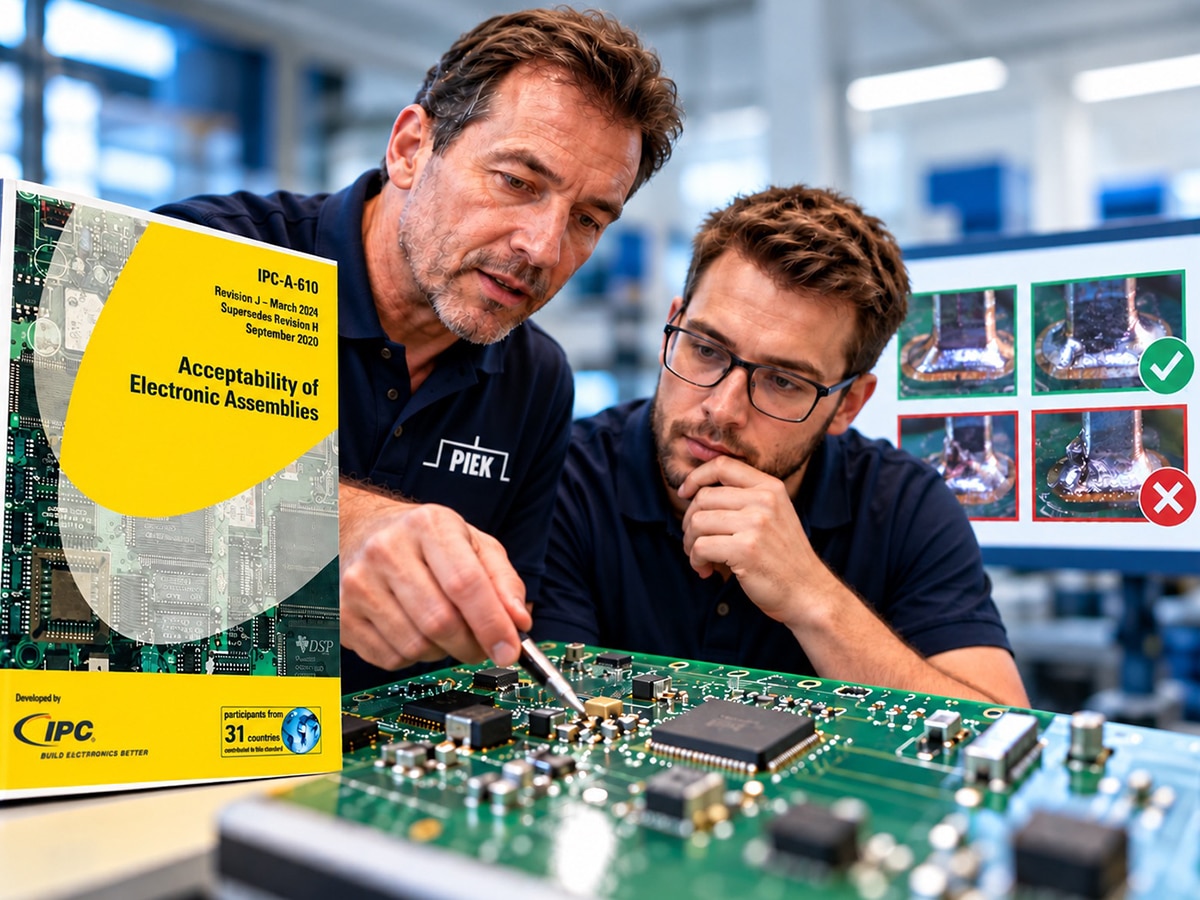
Anyone working in the electronics industry on a daily basis has almost certainly heard of IPC-A-610. Yet there are still quite a few misconceptions about what this standard and its associated certification actually mean. An experienced PIEK trainer regularly encounters these misunderstandings during his training courses.
“One of the first things I ask participants is what they expect from the training,” he explains. “I often hear: I’m going to learn how to solder. But IPC-A-610 is not a soldering course. It is primarily about recognising and evaluating electronic assemblies based on established acceptance criteria.”
Also joining the conversation is Thomas, a quality specialist at a medium-sized German electronics manufacturing services (EMS) company. He evaluates electronic assemblies for industrial customers every day. Before attending the course, he assumed it would mainly confirm what he already knew.
“I’ve been working with printed circuit boards for more than eight years, and I thought I was quite good at judging what was acceptable and what wasn’t. During the training, I discovered that some of my judgements were based mainly on experience and on how we had always done things within our company. Now I can explain much more clearly why something is or isn’t acceptable.”
Speaking the Same Language
According to the PIEK trainer, this is precisely one of the main advantages of working according to an international standard.
“Take a solder joint that causes a disagreement. The operator considers it acceptable, the inspector has doubts, and the customer rejects it. When everyone relies on their own experience, discussions arise. IPC-A-610 provides a common frame of reference.”
Thomas recognises this. “I’ve noticed that since the training, I communicate differently with our production staff. Instead of saying I don’t think this is acceptable, we can look at the criteria together. That makes the discussion much more objective.”
Not Everyone Needs the Same Training
Another misconception is that everyone within a manufacturing company should complete the same IPC training.
“Operators, inspectors, engineers and quality managers all have different responsibilities,” the trainer explains. “That’s why you first need to look at what someone actually does in practice. Only then can you determine which training course is most suitable.”
He also points out that the assumption that the strictest IPC product class is automatically the best choice is incorrect. The intended application of the product and the customer’s requirements determine which class is appropriate.
The Certificate Is Just the Beginning
Thomas initially attended the course mainly to obtain his certificate. “But in the end, I’m taking away something else. I now look more critically at our processes and ask more often why we accept or reject something.”
The trainer smiles. “Then the training has achieved what it was meant to achieve. Of course, the certificate is important. But quality doesn’t come from a certificate hanging on the wall. Quality comes from people understanding what they do, applying the same criteria and putting that knowledge into practice every single day.”
IPC certification is therefore not an end in itself, but a practical tool for continuously improving quality within an organisation.
Would you like your employees to receive training from the training centre for the electronics interconnection industry? Contact Wendy Wings at support@piektraining.com or call +31 45 570 33 33.